
Explainer
What does RTP actually mean?
It is printed on every game in the lobby and almost universally misread. RTP is a long-run average across millions of rounds, which makes it an excellent guide to what a game costs and a useless guide to what happens to you tonight.
The definition, and the word doing all the work
RTP stands for return to player. It is the share of everything staked that a game pays back, expressed as a percentage: at 96% RTP, every €100 wagered returns €96 and the operator keeps €4.
The word carrying the entire sentence is average. Not “you will get €96 back”, not “you will get €96 back eventually”. It is the mean outcome across an enormous number of rounds — millions, not hundreds — and it is calculated from the game's mathematics rather than measured from your account.
That is why the figure is genuinely useful and genuinely oversold at the same time. It tells you precisely what the game costs to play in the long run. It tells you nothing whatsoever about tonight.
RTP and house edge are one number wearing two hats
House edge is simply 100% minus the RTP. A 96% RTP is a 4% house edge; a 97% RTP is a 3% edge. There is no additional information in the second number, and nothing is hidden between them.
Which one gets quoted is a matter of who is doing the talking. Studios and casinos publish RTP, because 96% reads as generous. Analysts and regulators tend to work in house edge, because 4% is what the game actually charges you and the smaller framing is harder to mistake for a discount. If you find yourself impressed by a 96% figure, try reading it as “this game charges 4% of everything I stake” and see whether it still lands the same way.
For context on the range: most online slots publish something between roughly 92% and 97%, and the difference between the ends of that band is enormous over a year of play. Two points of RTP will cost you far more than any bonus offer will give back.
Why your session will not look like the number
Here is the misconception worth killing outright: that a 96% game gradually hands you back 96 pence in every pound as you play, and the losing is a slow, even drip.
It is not. The average is assembled from wildly uneven pieces, and the fewer rounds you play the less your result resembles the average. Sessions do not converge on the RTP; they scatter around it, and the scatter is far wider than most players imagine.
A concrete illustration. Take a bet that pays ×96 and wins 1% of the time — that is a 96% RTP bet, exactly on the nose. Play it a hundred times and the single most likely thing to happen is nothing at all: the chance of not winning once across a hundred attempts is about 37%. Go to three hundred attempts and roughly one player in twenty is still empty-handed. Every one of those players is playing a game that returns 96%, and every one of them is at zero.
Meanwhile, the handful who did connect are well ahead of 96%. The average is perfectly intact across all of them. It just was not describing any individual person's evening, and it was never claiming to.
The four numbers people mix up
Most confusion about RTP is actually confusion between RTP and something adjacent to it. These describe genuinely different things, and two games can match on one and feel nothing alike because they differ on another.
| Figure | What it tells you | What it does not |
|---|---|---|
| RTP | Long-run cost of playing | Anything about a single session |
| House edge | The same thing, inverted | Anything RTP does not already say |
| Hit frequency | How often a bet wins at all | How much it pays when it does |
| Volatility | How widely results scatter | The average they scatter around |
Hit frequency is the one that catches people. A bet winning 80% of the time and a bet winning 1% of the time can carry identical RTP — the rare one simply pays proportionally more when it lands. A high hit frequency is not a generous game; it is a game that returns the same money in smaller, more frequent instalments.
Volatility is the same story told about the spread rather than the frequency. High volatility means individual results land far from the average in both directions. It does not mean the average is worse. It means you should expect to spend longer away from it.
The edge is charged on turnover, not on your deposit
This is the part that almost nobody explains, and it changes how the figure should be read. The 4% is not taken from what you deposit. It is taken from what you stake, every time you stake it — and money you win and then bet again is staked again.
Deposit €50 and bet it once, and your expected cost is €2. But you will not bet it once. You will bet a pound, win some back, bet that too, and the same coins will cross the table repeatedly. Each crossing is charged.
The arithmetic falls out neatly: divide your bankroll by the house edge and you get the total turnover it supports on average. At a 4% edge, €50 supports roughly €1,250 of turnover before it is gone — about 1,250 bets at €1 each. This cuts both ways, honestly. It is why a modest deposit lasts far longer than dividing it by your stake suggests. It is also why a fast game can get through that turnover in an evening while a slow one takes weeks, at identical RTP. Our piece on what an instant clicker is covers what happens to that timeline when the round animation is removed entirely.
A game where the RTP genuinely does not move
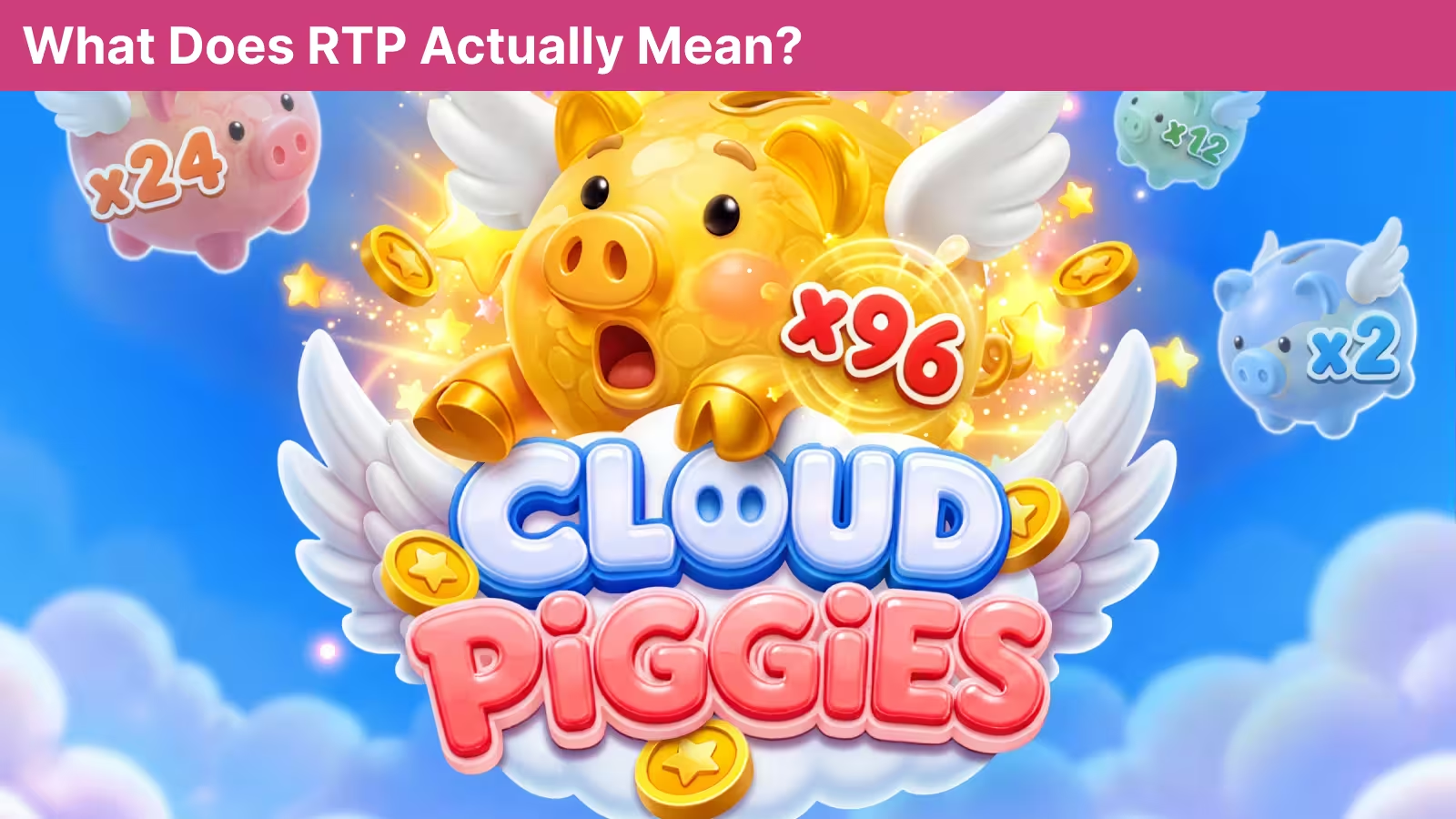
Cloud Piggies is a clean demonstration of everything above, because it puts nine different bets at one RTP in front of you simultaneously.
Every piggy tier returns the same 96%. The ×1.2 piggy bursts on 80% of taps; the ×96 piggy bursts on 1%. Both are 96% RTP bets, and the game is not being more generous at either end — the multiplier and the win chance are tuned against each other so that the product stays put. Our guide to the nine tiers works through the full ladder and the paytable.
What that isolates is the thing RTP was never measuring. Choosing a tier does not change your expected return by a hundredth of a percent, and it completely changes what an hour feels like: a steady drip of small wins, or thirty-seven-in-a-hundred odds of a completely blank session with a large payout somewhere behind it. Same number. Different game.
That is the practical use of understanding RTP. Not as a lever — you cannot move it — but as a way of seeing which of a game's numbers are actually offering you a choice. RTP is fixed and tells you the price. Volatility is yours and tells you the experience.
Check the RTP at your casino, not in a review
One practical warning to finish on. A game's published RTP is not always the RTP you are playing. It is common practice across the industry for studios to ship several configurable versions of the same title, and for the operator to choose which one to run — so the same slot can be 96% at one casino and several points lower at another, under the identical name and artwork.
Review sites quote whichever figure they were given, and they are frequently out of date. The only reliable source is the in-game information screen at the casino you are actually sitting in, which is obliged to state the return in force for you. It takes about fifteen seconds and it is the single highest-value check available to a player, because it is one of the only game parameters that genuinely varies between venues.
Worth knowing who stands behind the figure, too. Independent testing houses certify that a game's random number generator behaves correctly and that its stated return matches its actual mathematics — Turbo Games' titles carry per-game certification from BMM, as listed on the studio's own site and covered in our where to play guide. Certification is what separates a published RTP from a marketing number.
See 96% RTP In The Free DemoThe typical RTP range quoted for online slots describes the market broadly and not any specific title. Cloud Piggies specifications are as published by Turbo Games. Turnover and probability figures here are expected values calculated from stated mathematics — actual results vary, and no understanding of RTP improves your expected return. Real-money gambling is for players aged 18 or over — please gamble responsibly.